Language management in bilingual families in Kazakhstan
Author: Venera Kazi, Maqsut Narikbayev University
Abstract:
Language policy consists of three components: language practice, language ideology, and language management. Language management can be categorized into explicit and implicit (Spolsky, 2004). Parents may explicitly enroll their children in language courses or implicitly influence them through everyday language practices by using a particular language in family interactions. The current study examined how bilingual families in Kazakhstan manage the language decisions, such as the choice of which language to speak at home and introduction of English language. Most studies on language policy in Kazakhstan focus on governmental instructions; therefore, this research attempts to shed light on the underexamined context of managing the language in households. A basic qualitative design was chosen, and five semi-structured interviews were conducted. Five students from private Kazakhstani institution were chosen for this study. Findings show that parents can implicitly set a model for the default language at home and explicitly promote Kazakh and foreign languages. These findings have significant implications for understanding how implicit and explicit strategies function and can be applied in policy and pedagogy.
Keywords: Family language policy, language management, Kazakhstan, trilingual policy
Introduction
Language management within family language policy refers to explicit or implicit decisions made to influence language use (Spolsky, 2004). It can include enrolling children in language courses, encouraging the usage of a particular language, or restricting another language. In Kazakhstan, families actively navigate language planning in a context where Kazakh is a state language, Russian is a language of interethnic communication, and English is promoted through education (GOV.KZ, 2021). The national language policy of Kazakhstan promotes trilingualism, so citizens achieve proficiency in Kazakh, Russian, and English languages (President of the Republic of Kazakhstan, 2010). However, there is often a mismatch between the state goals and actual family language practice. According to Terlikbayeva and Menlibekova (2021), the Kazakh language still lacks the same social prestige as the Russian language, while Russian and English are favoured better education prospects.
The objective of this research was to examine how Kazakh, Russian, and English are managed in bilingual families in Kazakhstan. Most studies have focused on language policy on the macro level, and little attention has been given to family-level language management (Aksholakova & Ismailova, 2013; Smagulova, 2008). Furthermore, the current study explored the experience of adult children from bilingual families, focusing on how their families navigate the three languages. The findings provide insights into family language management from children's perspective because it was often overlooked in favour of parents' views. This study further contributes to the understanding of multilingualism in Kazakhstan from a family perspective. Moreover, this study uses terms such as top-down and bottom-up approaches in language policy, drawing on the definitions provided by Kaplan and Baldauf (1997), where the top-down approach refers to decisions made by authorities, while bottom-up involves decisions made by social groups.
The remaining part of the paper proceeds as follows: literature review, methodology, findings, discussion, and conclusion.
Literature Review
Defining Family Language Policy
Family Language Policy (FLP) is a subfield of language policy exploring how families manage their language use, ideologies, and practices in multilingual households. It appeared as an extension to the language policy that primarily deals with language planning in the government, schools and other official domains. Family language policy, on the other hand, deals with language planning within the family at the micro-level rather than through top-down policies (Wei et al., 2023).
In 2004, a seminal work on language policy was published by Spolsky, where he conceptualized family language policy as interconnected three components: (1) language practice - actual language daily use within a family; (2) language ideology - attitude towards a language; (3) language management - explicit planning to shape language use, such as enrolling children to language courses (Spolsky, 2004). Later, Spolsky (2012) emphasized that family language policy can be influenced by internal forces, such as parents' ideologies, and external forces as education. Exploring FLP in bilingual families is critical because ineffective planning can hinder heritage language maintenance and encourage the shift towards the more dominant language (Montrul, 2008). On the other hand, a well-planned family language policy can foster bilingualism and improve children's cognitive and academic abilities (Cummins, 2000).
This study employs the concept of language management to understand how bilingual families in Kazakhstan manage their children’s language use. By using this framework, the study seeks to find the explicit and implicit strategies that parents use. Understanding these strategies is important because it deepens the understanding of how family-level language management works in multilingual contexts. These strategies can also inform language policy and teaching approaches for bilingualism and heritage language maintenance.
Language management in immigrant families
Families engage in both deliberate and accidental language management. This means they can put effort into managing language use within the household and it can also happen intuitively (Caldas, 2012; Li et al., 2017). Spolsky (2004) called such practices as explicit and implicit language management. Implicit language planning is intuitive, lacking strategies and relying on instinctive preferences. In contrast, explicit language planning involves strategies to support a particular language, such as creating rules about which language to speak at home or enrolling children in language courses.
Bilingualism or multilingualism is often viewed as an advantage; therefore, families may adopt various strategies to help their children become proficient in several languages (Ding, 2019). Lao (2004) made a similar point, stating that Chinese-English bilingualism was promoted among Chinese people because of its advantages in education and career opportunities. This is exemplified in the work of Bose et al. (2024), who studied how immigrant Bengali families in Australia use digital devices and the internet for heritage language maintenance. The parents encouraged their children to use Bengali in online communication and engage with media such as movies and literature in their heritage language. In addition, parents can encourage the usage of dominant societal language.
However, parental language ideologies do not always align with their everyday language practices within the family. Mirvahedi and Jafari (2021) found such discrepancies among Azerbaijani immigrant families in Iran. Despite their cultural and emotional attachment to the heritage language, many participants did not promote it and instead prioritized Farsi, the dominant societal language. Similar mismatches between ideology and practices have been found in other works (Li and Sun, 2017; Yu, 2010). One possible explanation can be that parents fear overwhelming their children with a complex linguistic repertoire. Wang and Curdt-Christiansen (2020) found that some families in China believe that learning the home language would hinder children's acquisition of Mandarin and English. As a result, when parents do not promote heritage language at home, children often become proficient only in the dominant societal language (Li et al., 2017). While this shift can simplify communication, it can result in the loss of cultural traditions and identity.
Together, these studies indicate that language management is not a predictable process but one influenced by ideologies and external factors. Drawing on these insights, the current study analyses the dynamics of bilingual families in Kazakhstan.
Family language policy in Kazakhstan
Existing research has predominantly focused on top-down language policies and trilingual education (Mehisto et al., 2023; Tlepbergen et al., 2024). It leaves the process of managing the language in households underexplored. In particular, little is known about how bilingual families in Kazakhstan navigate the decisions about language at home. This study expands the scope of family language policy by including the context of non-migrant families from a post-Soviet country, where the heritage language is also the state language. It addresses the following research question: How do bilingual families in Kazakhstan manage the decisions about the Kazakh, Russian, and English languages use at home?
Methodology
The present study utilises a basic qualitative research design to explore the experiences of adult children from bilingual families (Merriam & Tisdell, 2015). This approach is suited to investigating the participants' emotions and subjective perspectives, allowing the researcher to derive thematic interpretations from the narratives. Given the prevalence of qualitative design in family language policy research, it aligns well with the current study.
Participants and Sampling
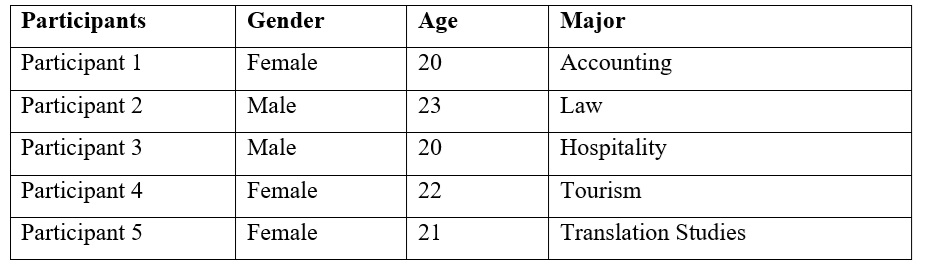
Five participants were chosen through purposive sampling. The sample consisted of three female and two male undergraduate students from private Kazakhstani institution aged between 20 and 23. Participants study different majors, namely accounting, law, hospitality, translation studies, and tourism. The inclusion criterion was the following:
Come from bilingual families proficient in Kazakh and Russian at any level, including receptive and productive skills;
This criterion ensured that the participants had personal exposure to multilingual environments, which made them suitable for exploring language management in family language policy.
Data Collection
The data collection included conducting semi-structured, face-to-face interviews. Interviews were guided by the protocol that began with ice-breaker and demographic questions and was followed by open-ended questions on language decisions in participants' households. Semi-structured interviews lasted approximately 30 minutes. Before the interview, participants were informed of their right to stop and leave the interview at any time.
Data Analysis
First, the audio recordings of the interviews were manually transcribed by the researcher. Second, the transcriptions were analysed through thematic coding. This included reading through the interview transcription, creating relevant axial codes, and finally grouping the axial codes into overarching thematic codes. Such an approach allows structured and interpretative analysis.
Findings
The research aimed to explore how bilingual families manage language use at home. Thematic coding revealed three overarching themes: implicit parental modelling, explicit strategies for the Kazakh language preservation, and parental support for foreign languages. Each theme is discussed in detail.
Implicit parental modelling
Language use shaped by parental language proficiency
This theme explores how participants' language choices and attitudes are shaped by their parents' proficiency level and habits. Participants reported speaking Kazakh and Russian with friends, while English was mostly used in language courses and social media. In the family context, Participant 2 and Participant 5 spoke Kazakh at home, whereas Participants 1, 3, and 4 used Russian. Participant 3 shared:
"I think it was just comfortable for them to, like, raise their kids in Russian, to explain something, but I don't know. My mother tries... She doesn't know Kazakh well."
The participant also noted that although he speaks Kazakh with friends, he avoids it at home because his mother does not understand it. Participant 5 commented:
"К примеру, дома я разговариваю в основном на казахском языке, так как у меня семья в основном на казахском разговаривает. В принципе все, но в основном, наверное, моя мама разговаривает только на казахском языке, и она не смешивает другие языки..." (For example, at home I mostly speak Kazakh because my family speaks Kazakh. Well, maybe, my mom speaks only Kazakh and she doesn't mix it with other languages).
This indicated that Participant 5 defaults to Kazakh at home because her family speaks mostly Kazakh. These examples illustrate that, despite being multilingual, participants tend to adopt the dominant languages spoken by their parents or caregivers. Therefore, parental language proficiency implicitly drives the participants to use a specific language at home.
Attitudes shaped by parental habits
Parental modelling can also influence participants' attitudes towards the languages. As Participant 1 put it:
"Она мне передала знания русского языка, я могу сказать так. Не ртом, но своими привычками и увлечениями, а я их просто переняла." (She passed on her knowledge of the Russian language to me, I can say so. Not with her mouth, but with her habits and hobbies, and I simply adopted them).
She described how seeing her mother read books in Russian and correct language mistakes influenced her current habits of speaking without mistakes and reading more books in Russian. It suggests that parents can unintentionally shape their children's attitudes and transmit values like speaking accurately.
Similarly, Participant 5 shared that watching her parents learn and speak foreign languages sparked her interest in foreign languages. She thinks it played a role in her decision to study Translation Studies in university. These examples show that parents can unintentionally shape language use and emotional engagement.
Overall, implicit parental modelling can influence language choice at home and the values that children attach to the languages. When parents default to one language out of their preference or proficiency, children try to speak the same language at home.
Explicit strategies for the Kazakh language preservation
The second theme explored how families adopt explicit strategies to preserve the Kazakh language. Participant 2 recalled that his parents and extended family intentionally spoke Kazakh to encourage him to learn the language. He did not understand what his family spoke about, and it served as a stimulus to learn the language. Similarly, participant 3 shared that his mother named objects in Kazakh in Russian sentences, as in "Подай мне қант" (give me sugar). Despite limited proficiency, his mother still tried to expose him to Kazakh. It may reflect parental belief in the language's cultural importance. Participant 4 shared a similar point that her mother sent her to a Kazakh school so she could learn her "mother tongue":
"My mother sent me to the Kazakh school because she was afraid because she can't speak Kazakh well. She only understands the speech, but she wanted me to know my mother tongue."
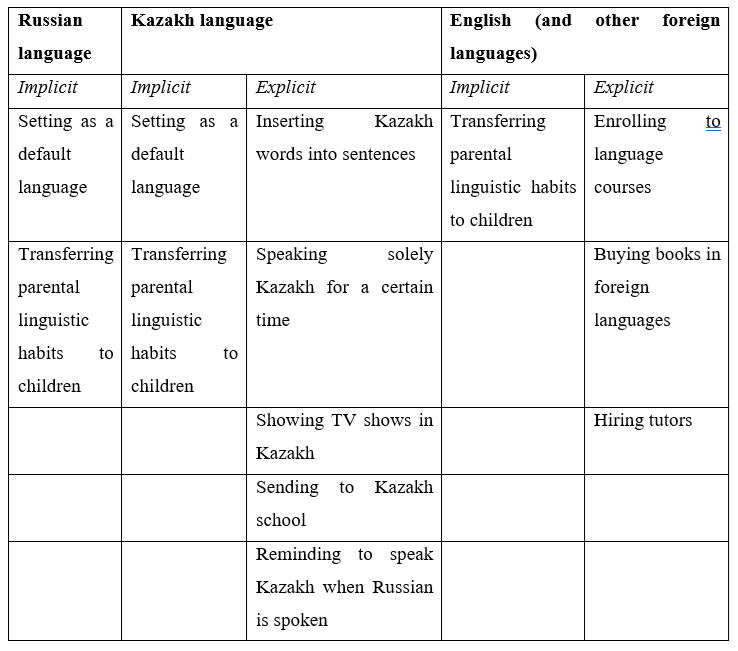
Taken together, the participants' shared experience demonstrates that their parents, despite the dominance of Russian at home, take explicit actions to preserve Kazakh. This reflects the parental view about language as a part of national heritage. Some parents might be uncomfortable with the idea of their children forgetting the language and, consequently, a part of their culture. As reported by the participants, parents use explicit strategies such as inserting Kazakh words into sentences, deliberately speaking only Kazakh, and sending children to Kazakh schools.
Support for foreign languages
Finally, the third theme explores how families support learning foreign languages, motivated by the perceived benefits of multilingualism or parents' unfulfilled dreams. Participant 2 commented:
"И английский это её (his mother's) мечта. Она её так и не выучила. Так что да, у них приоритеты, чтобы я учил английский." (English is my mother's dream. She didn't learn it though. So yeah, my family prioritises learning English).
The excerpt illustrates how the interviewee's mother transferred her unfulfilled dream onto her child. It demonstrates that parental encouragement to learn can stem from personal desires. The other reasons can also be general benefits of multilingualism, as Participant 3 said: "They've always been telling me the benefits of knowing a lot of languages". The support further extended to explicit strategies such as enrollment in foreign language courses. Participant 1 shared that her mother is still proud of the language courses because she thinks she granted her daughter a chance for a greater future. Similarly, the mother of Participant 4 associated languages as an opportunity in her future career:
"My mom believed, and also now believes, that the more language I know, the more doors are open for me and my future career so I can escape this country."
Interestingly, the interviewee's mother associates leaving Kazakhstan as an opportunity for success. It may indicate her mother's discontent with the state affairs or some personal dreams of working abroad.
These examples show that support for learning foreign languages, like support for speaking Kazakh at home, also reflects parental ideologies, as it may be their personal beliefs or dream. Here, mastering foreign languages was framed as a step towards success. Therefore, the parents enrolled the participants in foreign language courses or hired tutors. It is worth noting that, here, foreign languages do not imply just English. Some participants reported that they had been enrolled in courses in German, Spanish, and French, which indicates that some parents' interests went beyond just English.
Together, these three themes provide important insights into the management of language choice at home. Parents can implicitly set a default language at home due to their proficiency level or explicitly teach a certain language. Parents do not neglect the cultural importance of the Kazakh language despite their support for foreign languages. The results clearly indicate that parental ideologies drive the caregivers to take explicit or implicit management actions that can influence language choice at home. The table illustrating the used strategies reported by the participants can be found in the Appendix.
Discussion
As mentioned in the literature review, language policy consists of three components: (1) language practice - actual language use; (2) language ideology - attitude towards a language; (3) language management - planning to shape language use. Moreover, language management can be categorized into explicit and implicit, where explicit refers to intentional and implicit refers to unintentional planning (Spolsky, 2004). This study set out to examine how bilingual families navigate language management, that is, to see what choices families make to plan the language. However, it is important to note that two other components of language practice and ideologies are still present in the results because the components proposed by Spolsky are interconnected. Ideologies may function as a reason for language management and practices as a consequence. In other words, because the parents consider Kazakh to be a culturally important language (ideology), they teach their child the language (management), so the child starts speaking Kazakh at home (practice).
This study found that bilingual families in Kazakhstan employ implicit and explicit strategies at home. Parents can implicitly set a default language at home out of their proficiency level or comfort. It causes the other members of the household to switch to the default language, which consequently becomes the dominant language at home. Moreover, parents can implicitly transfer their linguistic habits to children, such as speaking accurately or learning foreign languages.
Parents also employ explicit strategies to preserve the Kazakh language. As reported by the participants, they were sent to Kazakh schools, taught words, and were exposed to Kazakh to encourage learning. This finding does not align with the studies of Mirvahedi and Jafari (2021) and Wang and Curdt-Christiansen (2020). They found that despite the emotional attachment to the heritage language, some families might be reluctant to promote it. In the case of bilingual families in Kazakhstan, the study showed that parents actively promote the Kazakh language even if their level is not always sufficient. A possible explanation for this might be that their studies focused on immigrant families while this study focused on non-immigrant ones. Here, Kazakh is a state language, and the families are constantly exposed to it; thus, they might be more proactive about its preservation.
Another finding is that parents also support the learning of foreign languages. They enroll their children on English language courses for their children's overall development and career opportunities. It indicates that parents think that multilingualism is beneficial and often associate it with success. This finding is consistent with what Lao (2004) and Ding (2019) found. Multilingualism was viewed as an advantage in career and education; therefore, parents promoted Chinese-English bilingualism. This study focused on the management of English courses; however, the results show that parents also take an interest in other languages. In addition to English, some participants were enrolled in German, French, and Spanish language courses. It demonstrates that some interest exists in language beyond the trilingual policy of Kazakh, Russian, and English languages.
Overall, the findings indicate that bilingual families in Kazakhstan manage language use at home through implicit and explicit strategies. They manage it implicitly by setting a model for the default language at home and explicitly promoting Kazakh and foreign languages. Nonetheless, these results may be limited to the small sample size of 5 participants from urban areas and middle-class families. Future studies with a larger sample size and from rural areas and other socio-economic background on the current topic are therefore recommended.
Conclusion
This study aimed to examine how families manage Kazakh, Russian, and English in Kazakhstan. Results show that families can unintentionally set a dominant language at home and intentionally promote Kazakh and foreign languages. Despite the benefits of multilingualism, parents do not neglect the promotion of Kazakh, whether they speak Kazakh or Russian.
These findings have significant implications for understanding how implicit and explicit strategies function and can be applied in policy and pedagogy. Current national policy heavily focuses on formal instructions and often overlooks implicit strategies. The current governmental policy can promote awareness campaigns of how unintentional habits can influence language use at home. Moreover, some parents promote Kazakh despite their limited level of proficiency. Parent-focused Kazakh language support could smoothen this process. Therefore, these findings would be of interest to policy-makers and educators.
However, being limited to the context of urban and middle-class families, findings cannot be generalized to all families in Kazakhstan. The management factors might differ across rural areas and people from different socio-economic backgrounds. Moreover, the current study is cross-sectional and captures only a snapshot of management in the households. Including a longitudinal component (in future studies) would allow tracking of how strategies evolve over time. Notwithstanding these limitations, this work offers valuable insights into family language management in Kazakhstan.
Bibliography:
Aksholakova, A., & Ismailova, N. (2013). The Language Policy of Kazakhstan and the State Language in Government Service. Procedia - Social and Behavioral Sciences, 93, 1580–1586.https://doi.org/10.1016/j.sbspro.2013.10.085
Bose, P., Gao, X., Starfield, S., & Perera, N. (2024). Understanding networked familylanguage policy: A study among Bengali immigrants in Australia. Current Issues in Language Planning, 25(4), 416–443. https://doi.org/10.1080/14664208.2024.2349405
Caldas, S. (2012). Language policy in the family. In B. Spolsky (Ed.), The Cambridge handbook of language policy (pp. 351–373). Cambridge University Press. https://doi.org/10.1017/CBO9780511979026.022
Cummins, J. (2000). Language, power, and pedagogy: Bilingual children in the crossfire. Multilingual Matters.
Ding, P. (2019). Family language policy and planning in transnational marriages in China. Chinese Journal of Language Policy and Planning, 4(2), 42–50. https://doi.org/10.19689/j.cnki.cn10-1361/h.20190204
GOV.KZ. (2021, October 18). Culture of Kazakhstan. GOV.KZ. https://www.gov.kz/article/64578?lang=en&ysclid=maatqnbjfs73053191
Kaplan, R. B., & Baldauf Jr, R. B. (1997). Language Planning: From Practice to Theory. Multilingual Matters. https://doi.org/10.21832/9781800418059
Lao, C. (2004). Parents’ attitudes toward Chinese–English bilingual education and Chinese-language use. Bilingual Research Journal, 28(1), 99–121.
Li, G., & Sun, Z. (2017). Canadian Chinese immigrants’ family language policies: Types and causes. Chinese Journal of Language Policy and Planning, 2(6), 46–56. https://www.researchgate.net/publication/323074001
Li, W., Qi, R., Zhu, H., Li, Y., Zhang, Z., Wang, L., Lei, J., Sun, B., Bai, J., Sheng, J.,& Fu, Y. (2017). Parents should read and write more with their children. Chinese Journal of Language Policy and Planning, 2(6), 80–88. http://yyzlyj.cp.com.cn/CN/abstract/abstract153.shtml
Mehisto, P., Winter, L., Kambatyrova, A., & Kurakbayev, K. (2023). CLIL as a conduit for a trilingual Kazakhstan. The Language Learning Journal, 51(6), 691–705. doi.org/10.1080/09571736.2022.2056627
Mirvahedi, S., & Jafari, R. (2021). Family language policy in the City of Zanjan: Acity for the forlorn Azerbaijani. International Journal of Multilingualism, 18(1), 1–23. https://doi.org/10.1080/14790718.2018.1545019
Montrul, S. (2008). Incomplete Acquisition in Bilingualism. John Benjamins Publishing Company. https://doi.org/10.1075/sibil.39
President of the Republic of Kazakhstan. (2010, December 7). State Programme of Education Development for 2011–2020 (Decree No. 1118). www.akorda.kz/uploadSPED.doc
Smagulova, J. (2008). Language Policies of Kazakhization and Their Influence on Language Attitudes and Use. International Journal of Bilingual Education and Bilingualism, 11(3–4), 440–475. doi.org/10.1080/13670050802148798
Spolsky, B. (2004). Language policy. Cambridge University Press. Spolsky, B. (2012). Family language policy – theoretical domain. Journal of Multilingual and Multicultural Development, 33(1), 3–11. https://doi.org/10.1080/01434632.2011.638072
Terlikbayeva, N., & Menlibekova, G. (2021). The Dynamics of Language Shift in Kazakhstan: Review Article.
Tlepbergen, D., Akzhigitova, A., & Zabrodskaja, A. (2024). Exploring the language policy and planning: A comparative analysis oflanguage practice in Kazakhstan and Estonia. Journal of Multilingual and Multicultural Development, 1–14. https://doi.org/10.1080/01434632.2024.2305642
Wang, W., & Curdt-Christiansen, X. L. (2020). Lost in translation: Parents as medium translators in intergenerational transmission. Current Issues in Language Planning. https://doi.org/10.1080/14664208.2020.1763022
Wei, L., Hua, Z., & Simpson, J. (2023). The Routledge Handbook of Applied Linguistics (2nd ed.). Routledge. https://doi.org/10.4324/9781003082637
Yu, S. (2010). How much does parental language behaviour reflect their language beliefs in language maintenance? Journal of Asian Pacific Communication, 20(1), 1–22. doi:10.1075/japc.20.1.01yu