The Imaginary Vietnamese
Author: Tam Nguyen, Goldsmiths, University of London
I reread Susan Sontag’s “Trip to Hanoi” at the beginning of summer in London. The essay recounts Sontag’s visit to North Vietnam in May 1968, three months after the Tet Offensive, a surprise military operation by North Vietnamese forces that shattered Americans’ illusion of victory in Vietnam. The Vietnam War itself, on the other hand, was among Sontag’s ‘war-trio’—Hanoi, Vietnam (1968), Yom Kippur, Israel (1973), and Sarajevo, Bosnia (1993)—which shaped her enduring intellectual engagement with military violence and its cultural consequences, later crystallized in works such as Illness as Metaphor (1978) and Regarding the Pain of Others (2003). “For the moment, it’s enough for me to be there as much as I can—to witness, to lament, to offer a model of noncomplicity, to pitch in. It’s [the] duties of a human being, one who believes in right action, not a writer,” says Sontag.[1] “Trip to Hanoi” marks her earliest critical reckoning of Western militant power abroad. Through encounters with North Vietnamese cadres and revolutionary leaders, Sontag sought to understand how a culture endures amid destruction, while confronting her own moral predicament as an American intellectual aligned with the anti-war movement of the 1960s.
As a Vietnamese, her psychoanalytic deduction about Vietnamese culture struck me quite profoundly, for I haven’t considered myself as part of a culture built upon “shame,” which she contrasts to American culture as something built upon “guilt.”[2] The Vietnamese sense of self-worth, Sontag elaborates, relies on a Confucian honor-based moral metric that also transcends time. ‘[...] this extraordinarily vivid sense of history—of living simultaneously in the past, the present, and the future—,” wrote the author, “must be one of the great sources of Vietnamese strength.”[3] This is perhaps Sontag’s first oversight, for she hadn’t considered that the modern Vietnamese language [chữ quốc ngữ] rarely indicates a time anchor in conversational settings, conjuring a linguistic illusion of timelessness. This, in combination with the nationalistic topic reiterated often during their conversations, might have created the impression that the North Vietnamese were speaking with an innate semantic heroism. On the other hand, this so-called ‘strength’ is not a recuperation from shame per se. It is thanatos-driven. A death drive that fed on the recent fictitious cult of martyrdom.[4] This text doesn’t attempt to chart the meaning of the Vietnamese people, but rather to refract their construction across multiple theoretical mediations: the people whose ideologies were considered the new pathology of the century in Western consciousness, whose realness was measured against their poetic perimeters, whose pain was immortalized through their deified stasis of the image—the imaginary Vietnamese.
**
From July to December 1968 (the year in which Americans executed numerous aerial bombings against the Việt Cộng [VC] grounds), the Research and Development - RAND Corporation conducted the “Viet Cong Motivation and Morale” project in South Vietnam. The report provides an empirical understanding of the Viet Cong soldiers, whose ‘insurgent’ nature was considered an exotic ideological pathology of the Cold War period. The interviewees were divided into two distinct groups: returnees, referring to captured or defected personnel of the VC army who expressed ambivalence or resentment towards North Vietnam; and non-returnees, referring to those who remained loyal to the revolution. In the way that the subjects are categorized in this study, the rhetoric of “return” has an anchor: to turn away from the insurgent communist doctrine, and to return to the protagonist cause of South Vietnam and America: “All the VC interviewed wore a high gloss of nationalist idealism over whatever degree of Communist ideology they had absorbed. Indeed, the central political theme of this movement, one which the VC preach convincingly to their supporters and the people generally, is that it is a revolution by, and for the Southerners, with only some welcome assistance from Hanoi.”[5]
On the methods of data collection, the report writes: “We usually introduced ourselves as sociology professors studying social conditions in GVN (Government of Vietnam) and VC areas and the behavior of men under the stress of revolutionary war. We tried to convince them that we were interested in them in this sense rather than as individual security cases, and that we could reat any information they gave us as confidential so that it could neither help nor harm them in the eyes of the GVN security agencies. [...] We addressed them respectfully and during the interviews offered them cigarettes, soft drinks, and sometimes beer, fruit and other foods.”[6] There were no records of post-investigation happenings, no mention of protective measures, release protocols, or follow-up monitoring. No mention of what happened to the non-returnees and returnees alike.
Reading the report, I’d sometimes imagine myself sitting in the integration room; other times, behind the one-way mirror, quietly watching. The thing about exposing oneself to foreign memories is that, given enough time, they may become yours. Some call it vicarious trauma. Others call it empathy.
**
In a way, Sontag intended to embark on her own mini-RAND project upon her arrival in Hanoi, but found herself in the position of the researched instead. Otherwise, it took her five whole days after landing in Hanoi to register the North Vietnamese as a “real” people.[7] At first, she was caught off guard by the excessive hospitality of the North Vietnamese to the point that she felt like her freedom was being taken away. She found it uncomfortable how she and her companions were only escorted around Hanoi by car and not allowed to bike.[8] She felt suspicious about the variety of dishes they were served during lunches and dinners, with the preconception about North Vietnam’s poverty on the back of her head.[9] She doubted the sincerity of their speech, which to her is an “empirical or descriptive notion” that is directly connected to “a mode of ethical aspiration.”[10]
Sontag then positions herself upon a new spectacle like this: “My sense of solidarity with the Vietnamese, however genuine and felt, is a moral abstraction developed (and meant to be lived out) at a great distance from them. Since my arrival in Hanoi, I must maintain that sense of solidarity alongside new unexpected feelings which indicate that, unhappily, it will always remain a moral abstraction. For me—a spectator?—it’s monochromatic here, and I feel oppressed by that.”[11] Interestingly, the question of aesthetics came into play: “What’s painfully exposed for me, by the way the Vietnamese talk, is the gap between ethics and aesthetics.”[12] What led the Vietnamese to exhaust their poetic instinct in speech?
To answer this question, I was inclined to discern the root of Sontag’s oppressive feeling. She determined that the Vietnamese were trying too hard to be her các bạn— “friends”—while she herself, subconsciously, was also trying to become theirs. There was no doubt of a transactional expectation at a political level from both ends. Nonetheless, attempting to undertake epistemic labor worthwhile of her trip to North Vietnam, Sontag subsequently constructed her understanding of the Vietnamese people around two distinct phases: the semantic anxiety of arrival, and the semantic illumination derived from staying. It is a plotline that we have seen before: the ethnographer arrives with an imagination about a people and a culture, alongside an earnest desire for such imagination to be shattered. But unlike the Vietnamese, whose morale was measured against the praxis of ideological return, Sontag entered.
If it is a privilege of a Western artist, in Hal Foster’s expression, to “return” to the traumatic real,[13] it is perhaps the misfortune of the Vietnamese artist to not even have a “real” to return to at the time. They were, instead, living it, amid the bombshells and crossfires that divorced one’s poetic instinct from their social functions. Sontag’s desire for intellectual discovery and subversiveness leads to the dialectical refraction of her own (vibrant) cultural repository. Such an approach also assimilates the Vietnamese people into an imaginary race. They read as inherently spectral, waiting to be demystified.[14] The Vietnamese’s poetic/aesthetic depravity—it’s not a psychoanalytic mystery that Songtag was dealing with. It’s the misplaced intellectual framing that she spiraled deeper and deeper into.
**
In my essay “Prosaic Trānsquīlus,” I wrote about my mother, the granddaughter of a Viet Cong veteran, as if she were an artist in a monograph, and her embroidery designs as if they were artworks, in a fictional cosmology that would be best described as pseudo-art historical. “The ‘plastic archive’ [which refers to the salvaged plastic sheets that my mother drew her embroidery designs on] is too prosaic to be an art form; not historical enough to be considered a craft. Therefore, I was certain that I wanted to write about the ‘plastic archive’ outside of art historical genealogy. Nevertheless, I still found myself writing to make a point, to make this essay useful. The more I wrote, the more it felt like I was digging my own grave in academia,” so I wrote.[15]
Since the text’s publication in Southeast of Now: Directions in Contemporary and Modern Art in Asia, a peculiar melancholy has been eating at me. In an email exchange with an editor regarding this experimental text and my other article, “On Difficulties,” I expressed the following:
‘While writing "Prosaic Trānsquīlus," I looked at Louise Lawler's entry "What Would Douglas Crimp Say?" in October 171, an issue specifically created to commemorate Crimp's passing. In the entry, a question was posed on a blank page: "What Would Douglas Crimp Say?"—nothing else follows.
I thought about that negative space being populated with radical ideas that Crimp (who was ostracized by the October team back in his day due to an editorial disagreement) would have said, but no longer could; and in the meantime, I also thought about how my ideas could only inhabit the negative plane of academic literature at this point in my career. My ideas are spectral, I have just come to realize recently.
"Prosaic Trānsquīlus" was a spectral text. It exists in the same space as other 'epistemically efficient' texts. It disguises itself as an academic essay, but its fraudulent status is exposed. It was about my mother, whom I love dearly. And yet, its status relies and feeds on that very fraudulence to occupy those few dozen pages in the journal.
"On Difficulties," on the other hand, is an attempt to break the membrane between this spectral realm of ideas and the more mainstream, officiated one. Yet, it is still half-spectral, a semi-academic text.’
In “On Difficulty,” I argue that ethnographic methods in Vietnamese art history are driven by the colonial rhetoric of academic mastery, and the “participatory” aspect of ethnographic methods is becoming more and more inaccessible for late-postwar art historians due to the complex effect of trauma.[16] Perhaps due to my own naivety at the time, I was adamant that I was dealing with something a lot more abstract and omnipresent. I was, in a way, also trying to make sense of my own “oppressive feeling,” trained as an ethnographer-historian at an American institution, embarked on my first ethnographic assignment a few years back, and wasn’t quite able to recover from the psychological distress that a certain interviewee had brought me.
To succumb to this abstraction (I, in fact, decided to not fight it), I included boxes of text that float between paragraphs, like ghosts. These include my analyses and criticisms of “masterful figures”—whom I consider responsible for the highly gatekept ecology of Southeast Asian art through political influences; my personal exchanges with them; my fragmented thoughts that did not fit anywhere in the main text; and even imaginary messages from the psychic abyss that kept me sane while writing the essay (I believe academic writing is a spiritual labor, so does my mentor Việt Lê, and his book Return Engagements: Contemporary Art's Traumas of Modernity and History in Sài Gòn and Phnom Penh). I have a habit of being brutally transparent with my writing (I cannot imagine doing otherwise), because after all, I am the sum of my professional network and what lies beneath it.
As I spent more years in academia, this abstract problem took on a systemic revelation. The neoliberal turn has transformed knowledge into epistemic capital, and some have learned to wield 'methodological innovation' like a sleight of hand. For the anthropological framework, it is the act of reducing a culture into consumable knowledge that I identify as problematic. It pushes the vessel of academic literature forward at sea, even at the cost of instrumentalizing the culture in question. This can be seen as the survival mechanism of Cold-War US academia when faced with complex bureaucratic and funding-related problems. Whereas programs such as the Southeast Asian Program (formerly the Department of Far Eastern Studies) primarily focused on China during its formalization at Cornell University in 1946, the nationwide anti-communist sentiment called for more strategic relevance of knowledge production during the Cold War, resulting in the inclusion of Southeast Asia as a way to for the department to secure funding from federal bodies such as the US Department of Education’s National Resource Center. The academic world is an economic constellation. I have tried my best to work and think outside of this constellation, and my “discoveries” (for lack of better words) lie in the gray areas—the spectral planes—the in-betweens.
**
Though the war is long gone, some of us never stopped being spectral in the Western eyes, even within the cosmology of knowledge where semantic cynicisms such as the prefix “Oriental” that attach to anything Asian have long been banished into the corner of shame of intellectual ethics. To create ripples, the non-Western scholar of Southeast Asian art must pass through two obstructive membranes: the bureaucracy/professionalism of academia (which involves getting a research degree, winning a grant, acquiring an OCRID number, while having nothing to do with the collective consciousness that links scholars as an trans-professional and affective network), and the spectral realm in which they are designated to reside (piercing through which will allow them to enter the said collective consciousness); and all the while navigating the burden of making sense of—and making peace with—their own histories and pains. As time goes by, memories become foreign, affects are conflated, either through natural forces or, in the case of Vietnam and Cambodia, through means of state-induced amnesia. As the non-Western scholar progresses through their career, they become distant from their subjects of study precisely because the work being done is historical, but the pain is a post-historical one.
**
The Vietnam War was a 21st-century goldmine for pain-based intellectualism. The photograph depicting Kim Phúc, a South Vietnamese girl, naked, covered in chemical burns from American napalm, won the Pulitzer Prize in photography. The imagery of the Napalm Girl signifies the moment when the ‘othered’ pain became citational in Western visual culture. “The history of the photograph offers a point of entry into a set of interlocking questions about the place of the Vietnam War in the American national imagination, as well as the role of iconic images in the construction of national memory,” says Nancy L. Miller.[17] Referencing Sontag’s essay “On Photography,” the author also points out how the affect of the photograph triumphs over the televised images of the Vietnam War. It is the stillness of pain, its powerful semiotic inertia, that Sontag finds especially compelling.
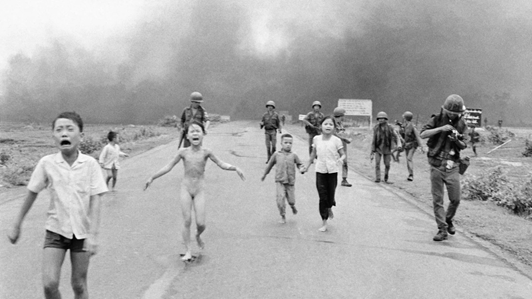
“The Terror of War” (commonly known as “Napalm Girl”), photograph attributed to Nick Ut (authorship currently being disputed) / The Associated Press, June 8, 1972.
Coming from a culture of pleasures, Sontag finds her intellectualism “impoverished” by this moral abstraction and the gap between ethics and aesthetics in “Trip to Hanoi.” There’s a charm to morally corrupted but materially wealthy societies like America, where intellectual pleasures thrive upon criticism of injustice. Such pleasures derived from cultural criticism were otherwise not possible in Vietnam then due to the monochromatic collective understanding of the Revolution and the moral rigidity produced by such a political commitment that resists even psycho-sexual desires (Sontag was impressed by how two male Vietnamese cadres lodging in the same room with a beautiful young nurse and were able to refrain themselves from raping her).[18] Sontag’s initial description of the North Vietnamese at this point renders them almost saint-like, sexless, and consequently, fictional.
Her account of North Vietnam is representative of the West’s tendency to identify its moral metric through looking at pain, yet acquiring an exclusive kick of pleasure from intellectualizing it. In Regarding the Pain of Others, Sontag determines that the sight of the varied war-struck bodies has a consumption limit. Too much exposure to images of bodily suffering in photographs could dull one’s empathy with them.[19] Therefore, the photograph triumphs over the images of suffering produced by mass media.[20] To Sontag, the visual faculty of pain is best felt when it is static and frozen in time. Such stillness evolves into the immortalization of a visual iconography, which can function independently from the constantly changing textual apparatus of an image. In another corner of American academia, we see another group of thinkers who exploited this independence between image and text by showing solidarity with the former. In October 77, Rosalind Krauss and Hal Foster attacked the textual apparatus, citing its vulnerability to pluralist notions (in a polemic anti-Kitsch fashion that took a strong hold of the October think-tank up until Krauss and Foster’s retirement from the editorial board).
It is the modality of movements and the semantic struggles found in texts that constitute greater proximities to objective truths. If there’s anything we have learned from the longue durée, it should be the fact that God is still, and to refuse the text is to refuse history itself. Otherwise, worshipping the stillness of the image is rather indistinguishable from endorsing a godly subject. Even though Sontag called for this privilege of the textual element in her theorization of imageries of sufferings, the pleasure derived from the reiteration of this thought-process in “Trip to Hanoi” is borderline sadistic.
**
As a personal response to this, I had looked at a Martha Rosler collage. The one-legged little girl appears to be hopping around a living room. I was compelled to ask: Where in America was the room being advertised? Who is this little girl? Does she also come with the estate (as a servant)? What is her name?
The original photo in which the figure was extracted was taken by Larry Burrows. Her name is Tròn. She had sustained injuries from a US helicopter’s machine gun, leading to the amputation of her leg. In Burrow’s original photo, she is observing her prosthetic being made by a craftsman. I put the two images side by side. By taking Tròn (whose name translates to, ironically, “round” or “whole”) out of her recovery context, Rosler reintroduced her into the spectacle of pain (one that is perpetuated by American consumerist culture in the case of this artwork), among many other collages made as part of House Beautiful: Bringing the War Home, created to contest the American government’s lies about their involvement in Vietnam. In doing so, Rostler also granted the image of Tròn a political purpose—one that thrives upon the perpetuation of her namelessness, of her missing limb, and conceptual displacement. Here, by talking about the textual knowledge of these images—about the duality between the photo and the collage, I was able to undo Tròn from the Rostler’s otherwise eternal dimension of pain. It is something sort of a conceptual exorcism, if I could put it that way.
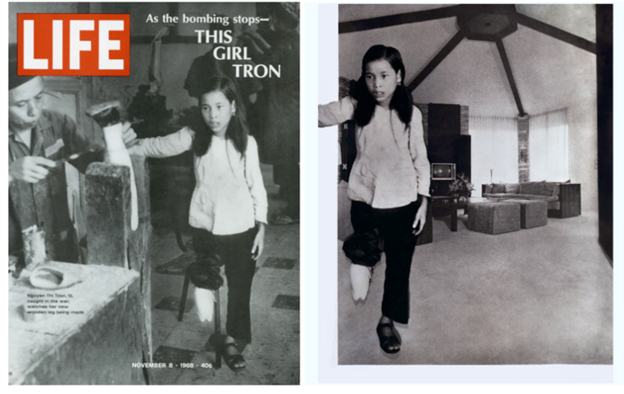
Right: The cover of LIFE magazine, November 8, 1968, featuring a photograph by Larry Burrow; Left: Martha Rostler, Home Beautiful: Bring the War Home, 1967-72.
Tròn was shot by the Americans while gathering vegetables and firewood in South Vietnam. My mother, who lived through the last decade of the war in South Vietnam, once told me she also used to do the same thing while avoiding crossfires between opposing forces. Personality-wise, my mother possesses the candidness of Southern peasants. She is as loud as a person can be. She has no filters and says what occurs at the top of her head. She hums rhymes about rice harvests, honest labor—and for my brother and myself—lullabies, but this is the most poetic she can get.
Time and time again, we have to engage ourselves with the Western aesthetic metric of pain to become real. Yet, the prosaic nature of Vietnamese life and memories is apparent. A prosaic culture is the easiest to be theoretically instrumentalized. It offers the theorizer a peace of mind, perhaps knowing that no intellectual pleasure would be missed if this culture becomes assimilated or perishes. This lack of poetic instinct, art historians, namely Philip Rawson, sometimes call it late-bloomed modernism.[21] The most pressing problem now is perhaps fighting against our poetic extinction, and contesting the notion of the imaginary Vietnamese, whichever comes first.
Bibliography:
Donnell, John C., Guy J. Pauker, and Joseph Jermiah Zasloff. Viet Cong Motivation and Morale
Dror, Olga. “Establishing Hồ Chí Minh's Cult: Vietnamese Traditions and Their Transformations,” The Journal of Asian Studies 75, no. 2 (2016): 433-466.
in 1964: A Preliminary Report. RM-4507/3-ISA. Santa Monica, CA: RAND Corporation, 1965.
Miller, Nancy K. “The Girl in the Photograph: The Vietnam War and the Making of National Memory.” JAC 24, no. 2 (2004): 259–276.
Nguyen, Tam. “On Difficulties: The Postwar Vietnamese Art Historian in the Face of Ethnography.” Southeast of Now: Directions in Contemporary and Modern Art in Asia 8, no. 2 & 9, no. 1 (2025): 230–253.
Nguyen, Tam. “Prosaic Transquilus: A Visual-Textual Meditation on Craft and Writing.” Southeast of Now: Directions in Contemporary and Modern Art in Asia 7, no. 2 (2023): 184–199.
Sontag, Susan, “The Art of Fiction No. 143,” interviewed by Edward Hirsch, The Paris Review, Issue 137, Winter 1995.
Sontag, Susan. “Trip to Hanoi.” In Essays of the 1960s & 70s, edited by David Rieff, 473–495. New York: Library of America, 2001.
Sontag, Susan. Regarding the Pain of Others. New York: Picador, 2003.
******************
[1] Susan Sontag, “The Art of Fiction No. 143,” interviewed by Edward Hirsch, The Paris Review 137, 1995. https://www.theparisreview.org/interviews/1505/the-art-of-fiction-no-143-susan-sontag.
[2] Susan Sontag, "Trip to Hanoi," in Essays of the 1960s & 70s, ed. David Rieff (New York: Library of America, 2001), 493.
[3] Ibid., 475.
[4] See Olga Dror, “Establishing Hồ Chí Minh's Cult: Vietnamese Traditions and Their Transformations,” The Journal of Asian Studies 75, no. 2 (2016): 433-466. This essay traces the formation of a “political religion” centered around Hồ Chí Minh, making him not only a leader with political significance in wartime Vietnam but also with spiritual significance. This phenomenon, the Dror argues, was enabled by numerous ghost-written autobiographical accounts (some of which were allegedly written by Hồ himself), which constituted a mythical narrative about Hồ’s political accomplishments and outstanding moral virtues. The author also points out that this narrative of Hồ’s life is also connected to the pre-modern lineage of real and mythical heroes of Vietnam’s nation-building history.
[5] John C. Donnell, Guy J. Pauker, and Joseph Jermiah Zasloff, Viet Cong Motivation and Morale in 1964: A Preliminary Report, RM-4507/3-ISA (Santa Monica, CA: RAND Corporation, 1965), 35.
[6] Ibid., 40.
[7] Sontag, “Trip to Hanoi,” 484.
[8] Ibid., 482.
[9] Ibid.
[10] Ibid., 490.
[11] Ibid., 473.
[12] Ibid., 472.
[13] See Hal Foster, The Return of the Real: The Avant-Garde at the End of the Century (Cambridge, MA: MIT Press, 1996).
[14] It is also important to note that Sontag and her peers were accompanied by Vietnamese intellectuals for the majority of their stay in Hanoi, which could have constituted a selective bias in her ethnographic reduction of the essence of the Vietnamese people.
[15] Tam Nguyen, "Prosaic Trānsquīlus: A Visual-Textual Meditation on Craft and Writing." Southeast of Now: Directions in Contemporary and Modern Art in Asia 7, no. 2 (2023): 184.
[16] See Tam Nguyen, “On Difficulties: The Postwar Vietnamese Art Historian in the Face of Ethnography,” Southeast of Now: Directions in Contemporary and Modern Art in Asia,
Volume 8, Number 2 & Volume 9, Number 1, March 2025, pp. 230-253. The current online version of the article has been altered. The original version of the text has been archived here: https://www.academia.edu/129562273/On_Difficulties_The_Postwar_Vietnamese_Art_Historian_in_the_Face_of_Ethnography
[17] Nancy K. Miller, “The Girl in the Photograph: The Vietnam War and the Making of National Memory,” JAC 24, no. 2 (2004): 262.
[18] Sontag, “Trip to Hanoi,” 495.
[19] Susan Sontag, Regarding the Pain of Others (New York: Picador, 2003), 105.
[20] Ibid., 19.
[21] See Philip S. Rawson, The Arts of Southeast Asia (London: Thames and Hudson, 1967).